
THE FIG TREE AND THE HEIFER by Awadifo Olga Norah.
Sep 16, 2026
Story
Seeking
Action
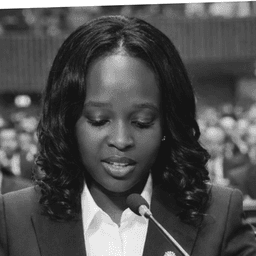

**Awadifo Olga Norah** is a Ugandan lawyer, legal scholar, author, and poet, and one of Uganda's Most Influential Women, as recognised by New Vision. Her literary work examines Africa's inherited past, the roots of its conflicts, and the ethical lessons embedded in its peoples and lands. She is the author of three books, *Victorious Tales*, *Echoes of Wails*, and *Stains on a Cowrie Shell*, and her writing centres on human rights, peacebuilding, and transitional justice.
The circular found Kirandu the way most decrees from the capital found it: three weeks late, water-stained along one fold, smelling faintly of the diesel truck that had carried it up the escarpment road. Adaeze Solongo unpinned it from the district noticeboard herself, because the clerk who should have done so was home nursing a fever, and she read it standing in the doorway of the co-operative office with a moth already circling the single bulb behind her.
Twenty-five years, the paper said, since the Security Council had passed its great resolution on women, peace, and security. A jubilee. Somewhere in Geneva or New York, she imagined, there would be a cake cut for the occasion, and delegates in tailored blazers applauding a document that had never once, in her memory, arrived in Kirandu in time to stop a single burial.
She folded it into quarters and put it in her bag beside the seed catalogues, and walked home along the footpath where the red dust had been beaten into a fine powder by two decades of sandalled feet, thinking of her grandmother, who used to say that paper promises were *lanterns with no oil in them*: handsome to look at, useless after dark.
She had been seven when the militia crossed the river at Obeya ford. She did not remember treaties. She remembered the smell of her mother's hands, turmeric and woodsmoke, and the sound of the compound gate being lifted off its hinges and laid flat so it would not creak when the men who were left came home drunk and grieving. She remembered her mother, Nyamurunga, boiling the same pot of beans for four days running because there was nothing else, and feeding twelve children who were not all hers, because their mothers were dead or gone to the forest camps, and calling this, without irony, *keeping the house standing*.
It was Nyamurunga who once walked, barefoot because her sandals had split, fourteen kilometres to the neighbouring ridge to beg back a boy named Otema from the men who had taken him. She brought a heifer she could not afford to lose and a claim of shared blood four generations back that a less patient woman would have let go slack. She sat under a fig tree for three days, refusing tea until the elders on the other side offered it first, because to accept too quickly was to seem desperate, and desperation, she told Adaeze years later, is the one thing a negotiator must never let the other side smell on her.
Otema came home. No treaty had summoned Nyamurunga to that fig tree. No mandate had trained her in the choreography of patience and refusal that got the boy back alive.
Now it was Adaeze's turn to sit in rooms furnished with acronyms rather than fig trees. NAP. GBV. M and E framework. She had learned the vocabulary the way one learns a colonial language, fluently, usefully, and with a small ache at the back of the throat for the words it had displaced.
The circular wanted "case studies of impact." She thought of Halima, nineteen, who had come back from the camps in the hills with a baby on her hip and no bride price left attached to her name, as though the town's ledger of worth had simply struck her out and moved on. Adaeze had found her a machine, a treadle Singer bought secondhand in the market at Loyo, using money that was meant to come from the district's women's peace budget but had, as usual, arrived eight months late and a third short, the balance apparently absorbed somewhere between the capital and the escarpment the way rain is absorbed by a field already cracked from drought.
She wrote the case study anyway, because it was true. Halima now stitched school uniforms in navy and grey, forty of them a term, and no longer flinched at the backfire of the Loyo minibus the way she once had.
Under the heading *Constraints*, Adaeze wrote a second sentence she doubted would survive the journey back down the escarpment: *The agenda has given us words for what our mothers already did. It has not yet given us the money to do more of it.*
That night her daughter Chiara, eleven, sharp as a blade left out in the sun, asked what the meeting had been about.
"A promise," Adaeze said, "made a long time ago in a country far from here, that women would be part of making peace and not only part of surviving war."
"Are you making peace, then?"
Adaeze thought of the fig tree, the heifer, the three days of refused tea.
"I am keeping it standing," she said. "Some days that is the same work wearing a smaller coat."
"Then why does anyone need a promise from far away," Chiara pressed, "if grandmother already knew how, before it was written?"
Outside, a nightjar called twice and stopped. Adaeze did not answer at once. She thought of the seat that had not been offered her at the ceasefire talks in Bwoyo three months back, where men in ironed shirts had redrawn a grazing line without asking the widows who had buried their sons over that same strip of grass what peace, this time, would actually require of the living.
"The promise isn't for the women who already know," she said finally. "It's meant to make the men in the far rooms listen to what the women already knew. That's all it ever was. A door left unlatched. Not a peace, handed to us whole."
"Has it worked?"
"In pieces. For some of us. Never far enough, and never without us shouldering the door ourselves."
She did not sleep well. Near three she read the circular again by the light of her phone, at the paragraph promising "renewed commitment for the next generation," language she had read in some close variant every second year since she began this work, each renewal a small, well-dressed funeral for the last one's unmet debts.
She thought of the word a delegate had once used for women like her at a workshop in the capital: *architects*. She had turned it over afterward with real suspicion. An architect draws the plan; other hands raise the walls. She had never once been handed a plan. She had scratched her own into the dirt with a stripped stick, teaching a circle of widows the exact phrasing the district council would recognise as legitimate, because legitimacy, she had learned, is a dialect, and someone must teach it to those denied its grammar. That was not architecture handed down from above. That was architecture built from underneath, by women who had never owned the paper and so had used the earth instead.
Perhaps that was the truer word after all. Not women let, belatedly, into a house already finished. Women who had been raising the house the whole time, in rooms the world had not yet agreed to call a house.
By morning she had added one final line the circular had not asked for: *If the next twenty-five years mean anything, let them stop asking whether women belong in peacemaking, and start asking why peace was ever imagined without us.*
She sent it before caution could get to it, boiled her tea, and went to check on Halima's uniforms, due at the school gate by Friday, jubilee or no jubilee, funded or not.
Some peace cannot wait for the paperwork to catch up with it. It only asks to be stitched, one seam at a time, by hands that never needed anyone's permission to begin.