
The River of Storytelling: From Moonlight to World Pulse
Sep 29, 2026
Story
Seeking
Action


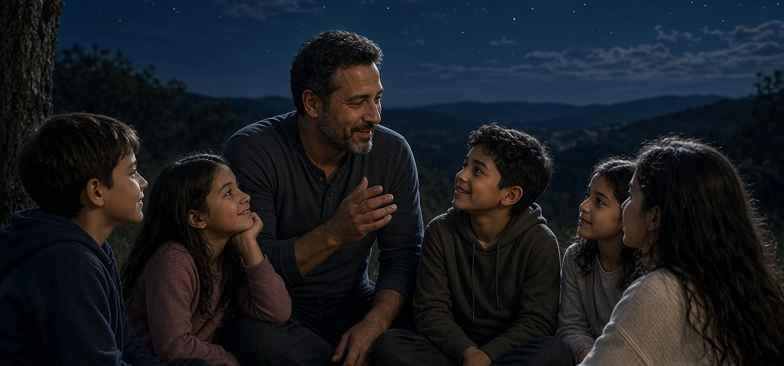
On an October night, the air carried my father’s voice clearly:
“Gather around, children… the electricity is out, and the sun has set. Come, let us pray, and then listen to a bedtime story.”
For us, a power outage was a secret appointment with beauty.
We ran to pray. My father stood as our imam, and we stood behind him in a small row. Then we gathered around him again beneath the white moonlight, while the colored stars scattered their secrets across the sky.
There, my father would open a door unlike any other door in our home.
The door to a story.
His stories were universal.
Through his voice, we crossed seas without ships, entered forests without our feet ever touching their soil, and met kings, heroes, lovers, and strangers whose names we did not know. Then we would return to our beds carrying entire worlds inside our heads.
I listened, spellbound.
I did not know that, in those nights, I was learning the first letters of my life.
I was learning that words could create places that existed nowhere but in the imagination, and that a story could make a stranger feel close, make the distant feel present, and allow someone we had never met to live inside a corner of our hearts.
I grew up.
And I entered journalism.
One day, I stood at the door of a newspaper carrying the story of a widow and her four children.
She carried little in her hands except her exhaustion and her children, yet I felt she was carrying an entire homeland of grief.
I sat with her.
I listened.
I wrote.
And when her story was published, I understood that journalism could do more than report what happened.
It could draw back the curtain on a hidden life.
It could say to the world:
Look… this woman is here.
From that day on, I began searching for the stories that lived behind the numbers and headlines.
The stories of women.
The stories of war.
The stories of displacement.
The stories of mothers carrying their children in one hand and the remains of their lives in the other.
Then technology began to change the shape of the road before me.
A story no longer had to die when it left the printing press.
It could travel.
I could publish it from my desk, and it could leave the screen and reach a place I had never seen.
A reader in a distant country could open my story at the very moment I thought I was writing alone.
Through digital platforms, my stories began crossing borders.
Then came grants.
Fellowships.
Trainings.
Invitations.
Opportunities I had never imagined possible for a journalist writing from Sudan.
I began to understand that technology was not simply a way to publish a story.
Sometimes, it was the door that led the story to a new opportunity.
Every platform was a window.
And every window carried a new breath of air.
So I kept walking.
Until one day, something else went dark.
War came to Sudan.
This time, it was not a power cut announcing the arrival of night.
It was my homeland itself sinking into the darkness of war.
And an ice settled over my heart that I did not know how to break.
I lost something of my ability to speak.
I could see the news. I knew how to write it. Yet suddenly, words felt like cold stones.
Then I entered World Pulse.
I thought I was simply entering another digital platform.
But they saw me differently.
They told me, in one way or another:
You are a storyteller.
The words remained suspended inside me.
A storyteller?
What were they trying to tell me?
I am a journalist.
I write.
I document.
I conduct interviews.
But who am I beneath all of that?
I did not understand then that World Pulse was not giving me a name.
It was holding up a mirror.
A mirror in which I could see something I had lost the ability to see in myself.
And with the awards, recognition, and stories that found their way into the world, I thought perhaps I had arrived.
But I did not feel that I had arrived.
Quite the opposite.
There was a strange emptiness inside me.
Or perhaps it was a fullness I did not know how to name.
Something that knocked within me whenever the world around me grew quiet.
So I turned to painting.
I sat before the blankness, laid out the colors, and let my hand search.
I thought I would find myself there, somewhere between blue and red, between light and shadow.
But the canvas remained silent.
Then I turned to music.
I began learning to play, practicing notes and the Arabic and Andalusian maqamat.
I placed my fingers on the instrument and listened as the melody took shape. I could feel something moving inside me, but it never quite reached where it needed to go.
Then I took courses in expressive dance.
My body began speaking for me.
I drew in the air what I could not say with words.
But the question remained:
What am I searching for?
I did not know.
I was searching for an inner river.
I could hear its murmur, but I could not see it.
I could feel its water, but I did not know its source.
Where does it begin?
And where is it going?
I kept search
kept searching among color, melody, movement, and words.
Until one day, I returned to the story.
And that was when everything changed.
It was not lightning.
It was not a dramatic moment.
It was more like an old door quietly opening somewhere inside me.
I stopped searching.
I felt something that had been clenched inside my chest for years finally loosen.
My breathing became deeper.
And the heart that had been running after something it could not name finally grew still.
As if, for the first time, I did not need to go anywhere else.
I had arrived.
I am a storyteller.
And in that moment, everything fell back into place.
The little girl who sat beneath the moonlight waiting for her father’s story.
The journalist who sat before a widow at the door of a newspaper.
The woman who carried the stories of women through war.
The writer who found, through World Pulse, a space to tell her pain, longing, fears, and dreams.
The poet whose images returned to her.
And the music that had been searching for its own language.
They were not separate paths.
They were tributaries.
All flowing into the same river.
The river of stories.
And then I understood why I had not found myself in painting alone, or music alone, or journalism alone.
I needed the place where all those voices could meet.
The story.
There, my heart wrapped itself in its shawl and grew still.
Its pulse softened.
It played its own music without my asking it to.
For the first time, I was not searching for something within me.
I was listening to it.
And its voice was clear:
Tell.
Tell the stories of women.
Tell the story of Sudan.
Tell of the pain that has no language.
Tell of the hope that is born in the darkest places.
Tell, because a story can cross where feet cannot.
And then I understood what World Pulse had done for me.
It was not simply a digital platform where I could publish my stories.
It was a window that technology opened between my small world and the larger world
Every word I wrote left the place where I was and returned to me carrying distant voices.
A message from a woman.
A comment from a reader.
Encouragement from someone I had never met.
Little by little, the world to which I had been telling my stories began to answer me.
The story was no longer simply a way for me to speak to the world.
It became a way for me to hear myself.
From that space came new chapters: awards, appearances on human development programs, the Noura Initiative, writing for magazines and websites, conversations and podcasts, and social media.
Then poetry returned.
I began publishing my poetry collections.
My poems found platforms, readers, and hearts I never knew had been waiting for them.
Then came invitations to speak at international events and conferences.
Even New York, on the sidelines of the United Nations meetings.
The story that had begun one night in our home had traveled a distance that the little girl I once was could never have imagined.
But none of these milestones was the greatest discovery.
The discovery was that, all those years, I had been telling my own story through the stories of others.
And I had been searching for myself in every story I wrote.
World Pulse became the mirror that allowed me to see her.
I saw the little girl.
I saw the journalist.
I saw the woman.
I saw the poet.
And finally, I saw the storyteller.
I realized that the river whose source and destination I had spent so long searching for had never been far away.
It had been flowing through my blood since that first moonlit night.
Its source was my father’s voice beneath the moonlight.
Its water was every woman who entrusted me with her story.
Its music was my passion for words.
Its course was technology, carrying my voice into the world.
And its destination...
was every heart a story managed to reach.
Today, when I think of technology, I do not see a screen, a phone, or a computer.
I see a bridge.
A bridge that allows a woman’s story to travel from a small room into the world.
A bridge that allows a woman to cross from isolation into solidarity.
A bridge that can carry the voice of a Sudanese woman, in a time of war, to an ear that never knew it was waiting to hear her.
I have learned that technology does not give a voice its value.
But it can give that voice reach.
And a platform does not create a storyteller.
But it can become the place where a storyteller discovers herself.
That is what World Pulse did for me.
It did not write my story for me.
But it helped me see it.
It did not give me a voice that had never existed.
It helped me find the voice that had lived inside me since that first night.
My father’s voice.
The voice of the story.
The voices of women.
And my own voice.
And now, whenever I return in memory to that night, I see the whole picture.
And I hear his voice:
“Come... let us listen to a bedtime story.”
He never knew that he was placing in his daughter’s hands a key that would remain with her for a lifetime.
A key that would open doors.
The door of journalism.
The door of poetry.
The door of art.
The door of solidarity.
The door of technology.
And the door to the women who are waiting for someone to hear them.
Today, I do not want my story to be the ending.
I want it to be a bridge.
A bridge for another woman to cross.
And another.
And another.
Until the voice that began as a whisper beneath the moonlight...
becomes a river that war cannot stop.
I am a storyteller.
And World Pulse introduced this storyteller to its digital platform, recognizing in my voice what I had not yet learned to see in myself.
Technology carried that voice across borders.
And the story...
is the river that flowed within me all these years, until at last, it found its course