
When Women Understand Their Worth, Communities Begin to Change
Sep 16, 2026
Story
Seeking
Collaboration


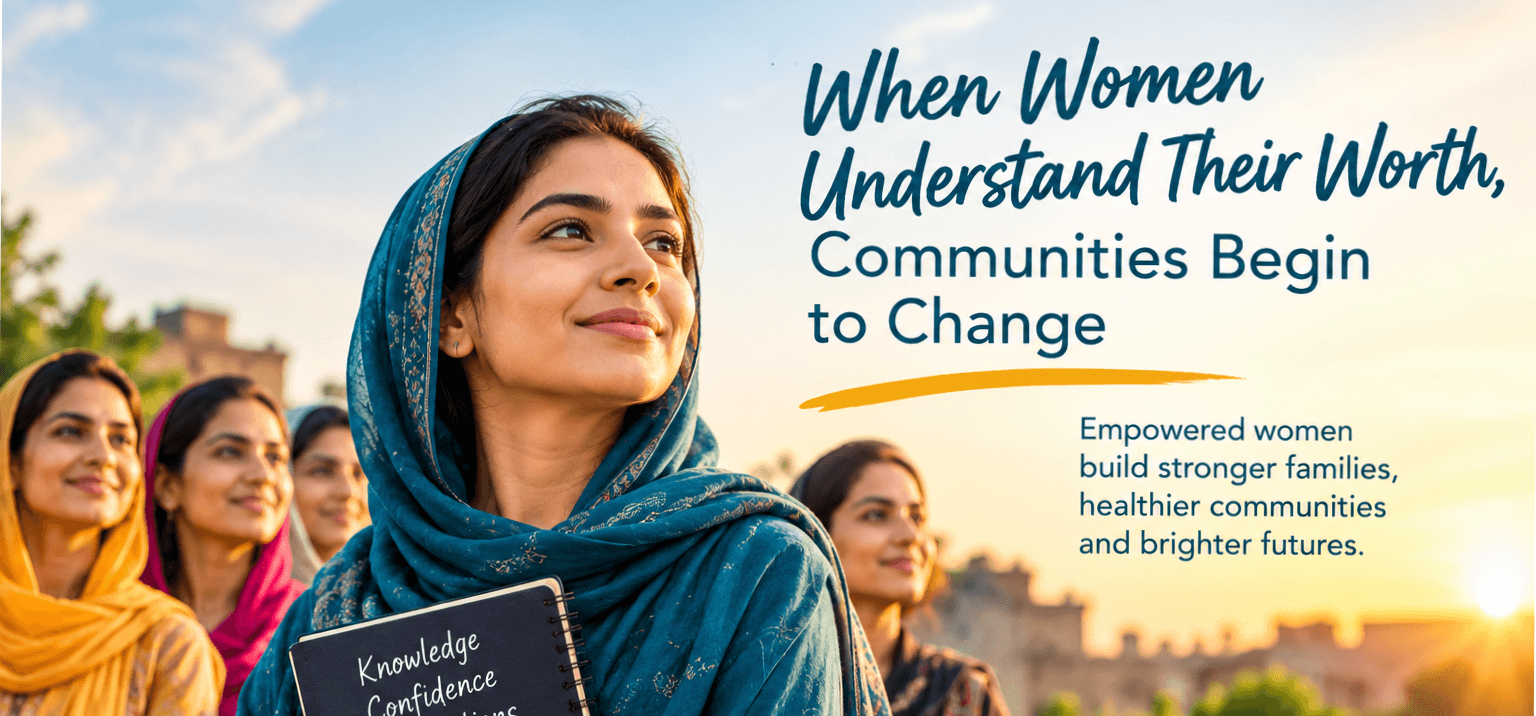
Photo Credit: ChatGPT
A woman can hold a family together, raise children, manage a household, support a business, care for elderly relatives, and contribute to her community—and still find herself outside the room when important decisions are being made.
This is one of the quiet contradictions of women’s lives.
We often celebrate women for their strength, sacrifice, patience, and ability to care for others. But when it comes to deciding where resources should go, whose voice should be heard, what the family should prioritize, or what direction a community should take, women are too often expected to step back.
Keeping Women outside of decision making is a problem that doesn't belong to only one religion, one class, one community, or one nation.
Across different societies, women have experienced different forms of exclusion from decision-making. The reasons and circumstances vary enormously, but the underlying pattern can be familiar: women are expected to contribute to decisions without necessarily being given equal authority to make them.
A woman may be responsible for managing a household budget but have little influence over major financial decisions. She may know what her children need but not be included in decisions about their education. She may understand the challenges facing her neighborhood but be absent from community meetings. She may have ideas about her workplace but hesitate to speak because
leadership is still perceived as someone else's space.
And sometimes, exclusion becomes so normal that women begin to believe that their opinions are less important.
That is where empowerment begins—not simply with giving women opportunities, but with helping women recognize the value of their own voices.
The decisions we don't see
Decision-making is not limited to parliament, corporate boardrooms, or government offices.
It happens at the dinner table.
It happens when a family decides how to spend its income.
It happens when parents decide whether a daughter will continue her education.
It happens when a community decides which problem deserves attention first.
It happens when an organization decides who gets an opportunity.
It happens every day.
Yet the people most affected by these decisions are not always the people who have the strongest voice in making them.
This is particularly important when we talk about women because women often perform enormous amounts of work that remains invisible or undervalued. Household management, caregiving, emotional support, and community contribution may not appear on a salary slip, but they influence the wellbeing and economic stability of entire families.
If women are contributing to the economy and sustaining communities, why should their voices be treated as secondary when decisions about those communities are made?
Empowerment begins with a voice
For me, women's empowerment is not about replacing one person's voice with another.
It is about creating spaces where women can speak, participate, negotiate, question, learn, lead, and make decisions.
A woman does not become valuable because someone finally gives her permission to speak. Her value already exists.
What changes is whether society creates the conditions for that value to be heard.
Education can help create those conditions. Economic knowledge can help create them too. Networking can connect women with people who can open new possibilities. Mentorship can give women the confidence to enter spaces where they previously felt they did not belong.
And when one woman gains knowledge, she must share it.
When one woman learns how to manage money, she can teach another.
When one woman finds the confidence to speak in a meeting, another woman may realize that she can speak too.
When women support women, empowerment begins from the household to the community.
This is also why I believe that economic education should be part of women's empowerment.
Every household is an economy.
Someone decides how income is allocated, what is saved, what is spent, what risks can be taken, and which needs should come first. Women are often deeply involved in these decisions, yet many are never given the opportunity to formally learn about economics or financial decision-making.
My vision through WomEconomics is rooted in a simple idea:
A woman does not need an economics degree to understand the forces affecting her household. She needs accessible knowledge, opportunities to learn, and the confidence to apply that knowledge.
But economic empowerment should not stop at managing a household. Women should also be able to participate in decisions about their workplaces, businesses, communities, and societies.
Because when women enter decision-making spaces, they do not leave their communities behind.
They bring their experiences with them.
Imagine a community where women are not merely consulted after decisions have already been made, but are present when those decisions are being discussed.
Imagine girls growing up seeing women negotiate, lead meetings, manage resources, start businesses, participate in public discussions, and make important choices.
Imagine a woman who once remained silent becoming the person who encourages another woman to speak.
That is how change can spread.
Women's empowerment is not achieved in a single workshop, certificate, campaign, or conversation. It is built through repeated opportunities to learn, participate, lead, and support one another.
The question is therefore not only:
“How can we empower women?”
Perhaps we should also ask:
“Why are women still being left outside the decisions that shape their lives?”
And perhaps the next question should be:
“What can each of us do to make room for their voices?”
Because when women understand their worth, they do not simply change their own lives.
They can influence families.
They can strengthen communities.
They can inspire other women.
And when more women are able to participate meaningfully in the decisions that affect them, the conversation about empowerment moves from giving women a voice to recognizing that their voices were always there.