
Women’s Mental Health Is a Conversation Across a Lifetime
Sep 27, 2026
Story
Seeking
Visibility

Hormones matter. But so do work, caregiving, relationships, sexuality, culture—and the digital worlds women now inhabit.
There is no single age at which women’s mental health begins to matter.
And there is no single hormone, diagnosis or life event that can explain it.
A girl enters puberty and discovers a changing body alongside a changing social world. A woman may move through relationships, sexuality, work, pregnancy, motherhood or the decision not to become a mother. She may carry professional ambition alongside invisible caregiving. Later may come perimenopause and menopause—another biological transition occurring in the middle of an already complicated life.
At every stage, biology matters.
But context matters too.
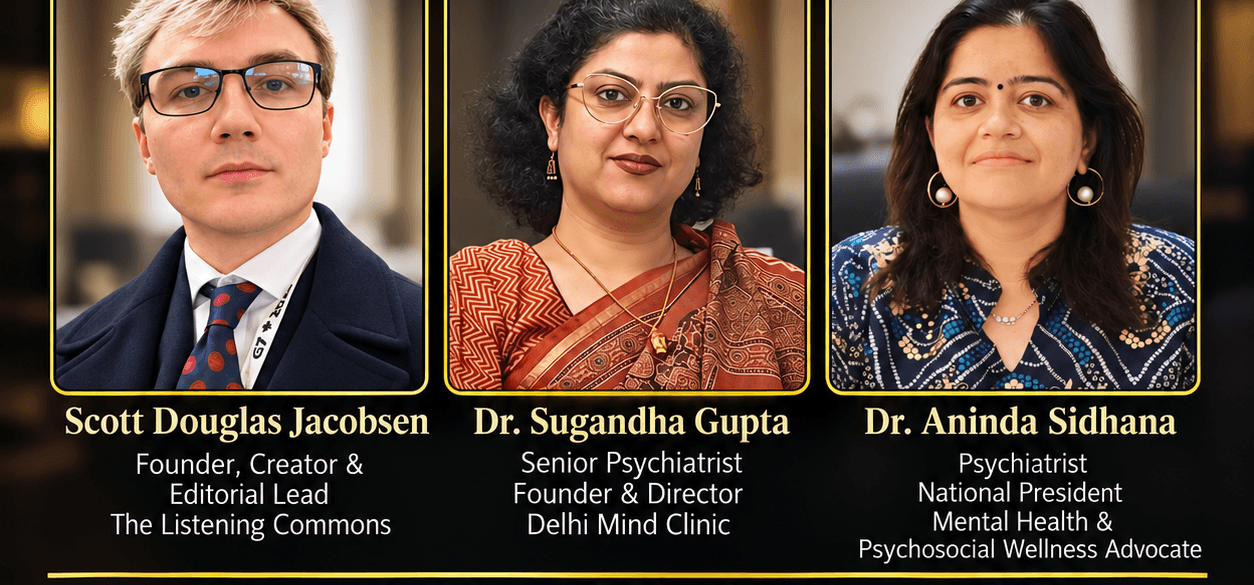
That is the starting point of our new conversation on The Listening Commons, where I joined psychiatrist Dr. Sugandha Gupta in conversation with Scott Douglas Jacobsen to explore:
Women’s Mental Health Across the Lifespan: Hormones, Work, Menopause & Digital Harm.
We cannot reduce women to their hormones
For generations, women’s emotions have sometimes been too easily attributed to hormones.
Yet correcting that mistake should not lead us to make the opposite one: pretending hormonal transitions have no psychological significance.
Puberty matters.
The menstrual cycle can matter.
Pregnancy and the postpartum period matter.
Perimenopause and menopause matter.
But none of these occurs in a vacuum.
The woman experiencing a biological transition may simultaneously be managing a career, caring for children or ageing parents, negotiating intimacy, carrying financial responsibilities, recovering from trauma, or navigating expectations about what a woman, wife, mother, daughter or professional is supposed to be.
The mind lives inside a body—but that body lives inside a world.
That is why women’s mental health needs a lifespan perspective.
And now there is another world: the digital one
Today, many women move continuously between physical and digital environments.
Comparison no longer ends when we leave a room.
Harassment does not necessarily stop at the front door.
Images of beauty, motherhood, relationships, professional success and supposedly perfect lives can follow us into our most private spaces.
Digital platforms can create extraordinary connection and community. They can also become environments of comparison, humiliation, surveillance, harassment and abuse.
If we are serious about contemporary women’s mental health, digital harm belongs in the clinical and social conversation too.
Perhaps we need to change the question
As psychiatrists, we often meet people once suffering has acquired diagnostic language.
Symptoms matter. Diagnosis matters. Treatment matters.
But sometimes another question needs to come first.
Instead of asking only:
“What is wrong?”
perhaps we should also ask:
“What has changed—in her body, her relationships, her responsibilities and the world around her?”
That small shift changes the direction of listening.
It moves us from symptoms alone towards context.
From pathology alone towards personhood.
And from crisis intervention towards the possibility of earlier recognition.
Listening before crisis
Families have a role.
Partners have a role.
Clinicians have a role.
Workplaces have a role.
Technology platforms and online communities have a role.
And women themselves deserve spaces in which speaking about distress does not require first proving that the distress is severe enough to matter.
Supporting women’s mental health should not begin only when someone reaches breaking point.
We need to become better at listening earlier.
That is ultimately what this conversation is about.
Not one diagnosis.
Not one hormone.
Not one stage of life.
But the changing relationship between body, mind, identity, relationships, responsibility and society across a woman’s lifetime.
And perhaps that is where better mental-health care begins:
not simply by asking what hurts, but by listening carefully enough to understand the life in which the hurt occurred.
🎙️ Listen: Women’s Mental Heal
th Across the Lifespan — The Listening Commons
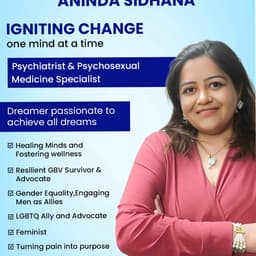
With Dr. Aninda Sidhana, Dr. Sugandha Gupta and Scott Douglas Jacobsen.
Listen to the full episode on Spotify�
Dr. Aninda Sidhana is a psychiatrist and psychosexual medicine specialist and National President of the WICCI National Women’s Mental Health & Psychosocial Wellness Council. Dr. Sugandha Gupta is a psychiatrist, Founder & Director of Delhi Mind Clinic, and Senior Advisor to the Council.